Thursday, September 5, 2013

Piemontese Offerings

Ultra Famous Ultra Expensive Alba White Truffles 

Hi there all, I know it has been a long time, too long, since my last post.  A lot has happened since then, and while I am apologetic for my lack of writing, I am pleased to say I am a 3rd Level Advanced Sommelier, Rudd Scholarship winner, and a recipient of the Zagat Guide 30 under 30 for the San Francisco Bay Area for 2013.  So yeah, I’ve been busy, but I’m back.  And we start back with one of my favorite wine regions on the planet, Piemonte (Piedmont), Italy.  The hills of Langhe are especially well known for their top class wines, but throughout the region are fantastic bottlings, from sparkling wines all the way through the spectrum to dessert wines.  Piemonte also boasts one of the longest histories with quality wine production, from the old kingdoms before Italy became a nation to the industrial wealth of Torino in more recent times.
While the most famous wines from Piemonte are the never more popular Moscato wines, like Mosacto d’Asti or Asti Spumante, to the wine of kings, the famous Nebbiolo wines from Barolo and Barbaresco, today we discuss a very approachable white and red.

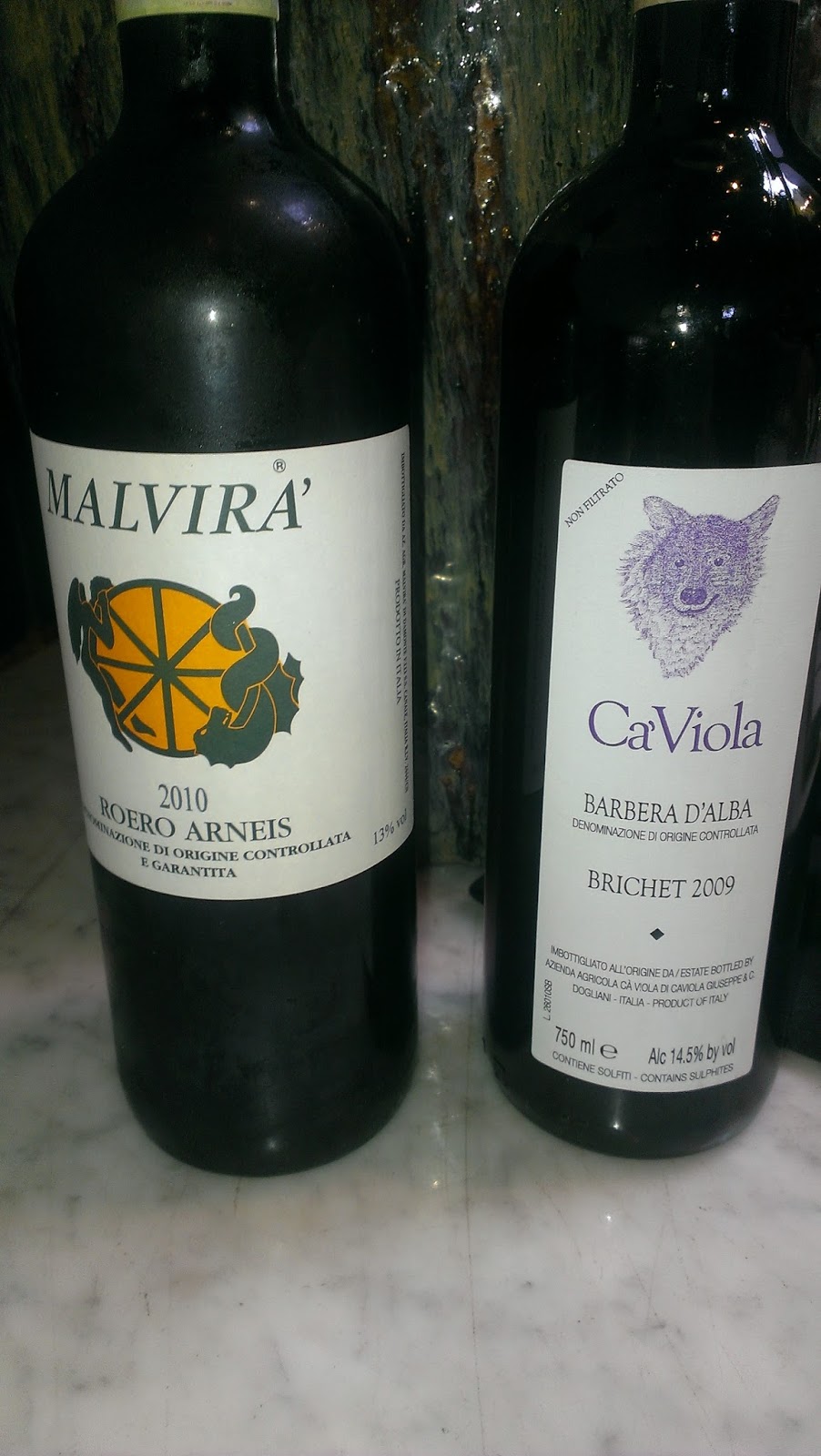
Malvira Roero Arneis 2010

Arneis, ‘the little rascal,’ is one of the more well known white grapes to be cultivated in Piemonte.  The Langhe hills so famous for Nebbiolo are home to the region Roero.  It sits just right across the Tanaro River from Alba, the epicenter of the Langhe.  Here this rascally grape thrives, alongside some very delicious good value bottlings of Nebbiolo.  Arneis in general is a good substitute for the Sauvignon Blanc drinker wanting to try something new.
Malvira was founded in the 1950’s and is now run by two brothers and their families.  They are one of the most regarded producers of Arneis, including their famous single vineyards Renesio, Trinita, and Saglietto.  This is their blend from their holdings.  The wine is satr bright and clear with a pale straw color.  Fruits like lemon peel and underripe peaches and nectarines come to mind, supported by white flower aromas and a sense of the sandy soils in Roero.  On the palate there is a bit more ripeness, with some mandarin and orange citrus additions as well as a riper element to the stonefruits.  Medium bodied with lean crisp acidity, very refreshing on the finish.

Ca’ Viola Barbera d’Alba Brichet 2009

While Nebbiolo gets all the fame and glory for Piemontese red wines, Barbera is actually the work horse of the region and the most planted red grape.  It is a grape with some recent popularity, lead mostly by producers wanting to make a more structured and complex style.  Better plantings with lower yields, longer extractions and more use of oak barrels (including a fair amount of producers using new French barriques) means that barbera isn’t just a quaffable pizza and pasta wine anymore.  While Asti is more famous for its production of barbera, Alba has a lot of it palnted in some choice locations as well.
Ca’ Viola sources its barbera from Dogliani, just south of Alba.  While this region is most famous for Dolcetto, barbera has been given some premium sites for palnting as well.  The wine has a deep ruby color with a magenta hue to the rim in the glass.  Lots of dusty red berries jump out of the glass, with hints of chocolate and green herb spices.  The wine has a very juicy palate, dry with a medium body and some tart acid tones on the finish.  The use of the French barriques to partially age this wine contributes to its richer texture and darker tones.
Cheers Friends 

Monday, June 4, 2012

SPQR & Poggio Antico


Hello all Happy Monday.  It is June and thus the beginning of summer.  Always a great time to get out and explore, visit wine regions and enjoy the art of wine tasting, or the skill of wine consumption depending on your philosophy.  I always encourage people in Northern California to be grateful and take advantage of all the fantastic wine and beautiful scenery of the vineyards we are surrounded with.
With that being said today I wanted to take a little time to share a recent evening hosted at SPQR Restaurant in San Francisco.  This is where I am currently employed and without a doubt enjoying the opportunity to work and study.  http://www.spqrsf.com/.  We recently welcomed Paola Gloder Montefiori, the daughter of Giancarlo Gloder who originally purchased the estate.  She was kind enough to share some of her fantastic wines with us.

Poggio Antico is a winery and estate located in the Montalcino region south of Siena in Tuscany.  The first vines were planted in 1970, and in 1984 Giancarlo Gloder purchased the estate.  The estate measures about 200 hectares, with about 32.5 hectares planted to grape vines.  The majority of this is Sangiovese, here called Brunello, with a sprinkling of Cabernet Sauvignon vines which go towards a newer concept blended wine from the property.  The estate is home to the highest elevation vineyards in all of Montalcino.

2009 Poggio Antico Rosso di Montalcino
   This wine is the same juice as the Brunello Normale, only bottled early.  There is no distinction made in the vineyard with the fruit, only in the cellar.  The wine is aged for about a year in large French barrels and allowed to settle in the bottle before release.
   Pale ruby in color with a medium concentration, bright red cherries and strawberries mix with a pleasant spice element which develops into warm eathenflavors on the palate.  The wine is well integrated with a long plush finish.  The wine to drink while the Brunello's mature.

2007 Poggio Antico Brunello di Montalcino Normale
   Moving on to the Brunello Normale, which is again the same juice as the the Rosso, you begin to understand what the aging of the wine does here.  Here we have 3 years in large Slavonian oak barrels before bottling and settling. 
   The wine shows more aging and a lower intensity of color, but the aromas have more depth.  Darker cherries with warm leather begin, backed by the classic roasted wood herb aromas.  Also a hint of nutmeg from the time spent in wood.  The tannins are noticably bigger here, and while this wine has a long life ahead, it was very apporachable and enjoyable in its youth.

2007 Poggio Antico 'Altero' Brunello di Montalcino
   "Altero,' or self-confident is a wine special to Poggio Antico.  It began in 1983 as a table wine out of a want to try something different.  Since its' first vintage Altero has always been aged for 2 years in French barrels, not tradtional for the production of Brunello di Montalcino.  In fact it was not until the laws were revised for the aging of Brunellos that this wine was able to apply for reclassification. 
   The aromas take a shift, but the essence of the estate is preserved.  The fruit goes darker and more black, while the spices of nutmeg and cinnamon become more dominant.  Also I found more of a meaty quality to the palate which left a savory element to a very long finish.  Not quite as open right now as the Normale, give it a couple years, if you can wait that long...

2006 Poggio Antico Brunello di Montalcino Riserva
  The Riserva selection is sourced from a parcel of vines which were the original plantings in the early 1970's.  The first year the wine is aged in French barrels, and then transferred for 2.5 years into large Slavonian oak botti (very large barrels).  This allows for the best of both worlds in flavor, as well as an opportunity to soften the naturally strong tannins.  This win was still very young and very tight, the tannins needing more time to unwrap themself.  2006 was an amazing year for Montalcino and this wine showed it.
   Black cherry and blueberry notes were drizzled with hints of aged balsamic vinegar and again a bit of a gamey/meaty quality.  The oak spices were there, but now more dressed with vanilla and lingered long after the wine was gone.  Give this wine a few years and it will be even better.

2004 Poggio Antico Brunello di Montalcino Riserva
   As a treat we were able to offer ethe 2004 Riserva as well, out of a magnum no less.  This was my favorite of the night because of its complex sturcture and also because it had been given a little more time to fully integrate.  Also a big full flavored vintage like 2006, this wine has a very long happy life ahead of it, that is if you can wait...

Cheers to All!

Jeremiah

http://www.spqrsf.com/

http://www.poggioantico.com/

Monday, May 14, 2012

A Sampling of Piemonte

A Sampling of Piemonte

Hi there all, hope all is well and all the Mother’s out there very much enjoyed their weekend and were treated well to celebrate all you do. In response to my love and obsession with Italian wine I have decided a great way to share this would be to share my thoughts on the wines that I am fortunate enough to work with at SPQR Restaurant in San Francisco. Our list is 99% Italian (we have a couple Champagne selections right now) and we get to showcase some very rare and unique wines. While not all of these wines may be familiar or easy to source, they should be out there since I am getting to try them.

My hope is to build a database of tasting notes for Italian wines which can be beneficial to many.

Today’s post will compare 2 Barbera wines and 2 Nebbiolo wines.

Cheers!


Wine #1 Braida ‘Montebruna’ Barbera d’Asti, 2010


Giacomo Bologna was the Barbera pioneer. Plantings in better sites to yield more intense wines, using new French barrique in aging of some of his wines, he was at the forefront to bring the grape to such fame. The Montebruna bottling comes from a single estate in Asti and is of DOCG status.

The wine is bright in ruby red color with a moderate concentration. Tart red cherries and plums mingle with violet flowers and subtle herbal notes. The 12 months in large barrels with the palate a soft round finish while preserving the bright acidity.

Ca Rome La Gamberaja Barbera d'Alba 1998
 
Wine #2 Ca’Rome Barbera d’Alba ‘La Gamberaja’ 2006


A classic style producer, Romano Marengo (hence Ca’Rome the house of Romano) this Barbera showcases the denser complexities that the soils of Alba deliver to Barbera. Also given the aging in the bottle more of the secondary qualities were able to emerge.

Slightly darker and denser in color, with more deep ruby and magenta. The use of smaller barrels, including barriques, deepened the flavors to more of an intense cherry and some anise spices. Also the subtle sweetness of the vanillin oak spice mingled with the juicy qualities of this wine on the palate. Medium tannins on a long finish.

Barbaresco Currá D.O.C.G. 2008 label

Wine #3 Sottimano ‘Curra’ Barbaresco 2005


From the 2 different bottling I have had from Sottimano I can say that their style is that of the more modern approach. The influence of oak in both the bottlings of this wine I have tried, along with a 2001 from another Cru they bottle showed that to me.

Warm fleshy cherry skins mixed with the toasty oak spice elements showed for an intense wine with only moderate complexity. Some dried dark tobacco leaf and black liquorice notes emerged, but the tannins were still a little austere for me.


Giacomo Grimaldi Barolo Le Coste 2004 750ML
Wine #4 Giacomo Grimaldi ‘Le Coste’ Barolo 2001


A very heady wine and a nice treat to get to try, the 2001 vintage is a classic, and while it is just past that 10 year mark, these wines still have much grip left ‘.Le Coste’ is a vineyard site in the town of Barolo in the famed Brunate Cru.

The flavors are very mineral driven with a lot of tart black cherry and black liquorice, with aromas developing hours after being opened. Greta finesse and integration, while still being a big robust wine.


Monday, April 30, 2012

Anaheim 2013: One Year and Counting....


The Advanced Sommelier Exam in Anaheim, California finished up last Friday and the newest Green Pins were introduced.  Congratulations to all who sat the grueling exam, and hats off to those who excelled and achieved passing honors.

For me, the countdown begins. I aim to sit the exam next year, 2013, in Anaheim.  That's one year and counting. 

The exam itself consists of three independent sections.  The scoring for each section is separate, not cumulative.  There is a Service exam, a Blind Tasting exam, and a Theory exam.

The service portion is much as it would be a restaurant anywhere, dealing with proper practice.  Things like champagne service, decanting, and pairing recommendations are common.

The tasting portion consists of the analysis of a selection of wines representing classic typicity for their provenance.  Things like region, varietal, and vintage are topics to be determined.

The theory portion is the written part of the exam.  It will consist of a series of questions selected to determine knowledge in a variety of regions, styles, and a full understanding of beverages outside of wine.

Signing off, back to the books...

Cheers

JNM


Monday, April 23, 2012

Tuesday Tasting April 17, 2012


Blind Tasting


Hello all, Happy weekend and warm weather to all. It’s been so nice in San Francisco the past couple days and people have been out and about. Hopefully we are all enjoying something tasty in our glasses this weekend.

So let’s talk about blind tasting. Every week I meet with some fellow Certified Sommeliers and we study in preparation for our Advanced Exam. One of the three portions of the exam is a blind tasting panel. So every week we meet and blind taste wines together. The rules are simple, one white and one red that would be ‘fair-game.’ A fair-game wine is one that is classic and very well defined, with distinguishable characteristics to its’ typicity. Sancerre, Chablis, and German Riesling are but a few white examples; Bordeaux, Red Burgundy, and Barolo are a sample of reds.

April 17th we met, 5 of us total. The solid core of three: Don, Rafael, and me. Dominque joined and so did Callie. We had some fun wines and it’s interesting to see how we improve each week. In total we tasted 10 wines, a bit of a marathon for our palates, but we are dedicated and thus powered through.

Wine #1 My White 2010 Bordeaux Blanc 60/40 Semillon/Sauv Blanc

Good easy drinking white with some good signs of being Bordeaux Blanc. Unfortunately it was not showing much signs of oak influence and thus made the guesses go a bit leaner. My bad.

Wine #2 Rafael’s White 2010 Albarino, Rias Baixas-Spain

I got some good notes of what this wine was about, and called Albarino in my initial, but went with Northern Rhone Viognier as my guess instead. Not too far off…

Wine #3 Dominque’s White 2010 Albarino, Rias Baixas-Spain

Another Albarino, back to back. This is why blind tasting like this can be so fun. Did I call Albarino here, nope haha! I thought it was a Pinot Grigio from Northern Italy.

Wine #4 Callie’s White 2004 Riesling Spatlese Mosel, Germany

German Riesling is one of those grapes where you really know what it is when you smell it. After that it’s all about figuring out where it is from and how old and how sweet it is. Spatlese is the ripeness level, and is definitely off-dry. I guessed that it was a 2006 German Riesling Kabinett from Rheingau, to the South of Mosel. I need to calibrate my Riesling sweetness levels.

Wine #5 Don’s White 2000 Graves Blanc, Grand Cru Classe 75/25 Sauv Blanc/Semillon

I was guessing this wine, and was happy with my synopsis, although my guess could have been better. I thought it was either Chenin Blanc or Semillon/Sauv Blanc from Graves-Bordeaux, probably about 7-10 years old. I guessed 2005 Vouvray Sec. I’m happy with the guess, but could have done better with the age/vintage.

Wine #6 My Red 2009 Cote de Brouilly, Cru Beaujolais-France Gamay Noir

Cru Beaujolais is fun stuff and a wine I like to carry and recommend to people. Everybody did pretty well with this wine.

Wine #7 Rafael’s Red 2007 Chinon, Loire Valley-France Cabernet Franc

This is a wine I need to get more exposure to. I got all the green qualities, but went new world South America. I guessed Cabernet Sauvignon from Chile. The struggle continues…

Wine #8 Dominque’s Red 2007 Rioja Crianza, Spain Tempranillo, Graciano

Rioja has been a wine that has plagued me for a long time. This guess of a 2005 Rioja Riserva may be a sign of enlightenment in the future. Keep dreaming.

Wine #9 Callie’s Red 2009 Pinot Noir, Santa Barbara-California

California makes a lot of Pinot Noir from a lot of different places. Then there is Oregon too with the Willamette Valley. I guessed 2010 Russian River Valley Pinot Noir. Not a bad try

Wine #10 Don’s Red 2006 Cornas, Northern Rhone Valley-France Syrah

So here is the red I was assigned to blind. It’s always good to end on a high note. Here I said 2007 Cote Rotie, another small appellation in the Northern Rhone Valley. The funny thing is in my notes I wrote Cornas first and scribbled it out.


No matter what at the end of the day the most important thing is to drink what you like.  I enjoy blind tasting, which is good given its importance in my profession.  Have a good week everyone, you will hear from me again soon.

Cheers!


Monday, April 16, 2012

My Apologizes, but I'm Back

Hello all,

first off my apologizes for my absence but I am back and ready to start writing again.

Tomorrow I will post a new overview of my blind tasting study session in the morning. 

A domani, Ciao.

Salute

Jeremiah Morehouse, Christmas 2010-Bordeaux

Tuesday, June 7, 2011

Tuesday Night Wines

Hey there everybody, sorry i have been super busy as of late, but not a valid excuse for neglecting my faithful readers and those looking to get heir quick fix wine info, and more importantly a great value bottle in the middle of the week. To catch everybody up I have been working for the last 3 months now as the Wine Director for Enotria Restaurant & Wine Bar (www.enotria.com).  In the last few weeks I have finally gotten down to a serious study schedule.  That's right, Level 3 Advanced Sommelier Exam, I want you.  I am studying hardcore, morning and night, drawing maps, taking notes, and lots and lots of flashcards!  It's a lot of work but it's really exciting for me, the thought of the preparation is daunting.  I plan to aim for taking the exam in the fall of 2012, so that's a little more than a year out.

But let's talk something more interesting, my Tuesday Night Value Wine of the Week.  With the warm weather finally looking like it wants to hang out this time around, I thought we would go with a easy white that is a crowd pleaser all around.

Fleur du Cap Chardonnay 2009, Western Cape-South Africa.

In anticipation for my 'Southern Hemisphere' tasting this Thursday, how about a great South of the Equator wine to get the theme rolling.  This project is run by Winemaker Andrea Freeborough, who was awarded Winemaker of the Year in 2010 by the South African Winemaker's Association.

The wine is a blend of fruit throughout the Western Cape area, is Barrel Fermented, and is ripe with citrus and tropical fruit, has the mouthfeel of a Chardonnay, but not as oak or buttery qualities to make it one dimensional.  This wine is great for the BBQ, backyard parties as an easy white to serve the crowd.

At only $10 per bottle this week on my Retail Sales Offerings, it's a great steal to stock up on for the summer!

Sunday, May 15, 2011

A Wine Bar in Madrid

Leon de Oro


Madrid, France

8-1-2011


In the land filled with one Tapas Bar after another, the capital city of Spain has many different things to offer to locals and tourists alike. The sites are amazing, the buildings beautiful, the central park vast and peaceful, and the food is pretty great too. Here, much like throughout Italy, pork reigns supreme. The famed Serrano Ham is in almost every window, with someone ready to hand slice some for the next plate going out. Many places offer a complimentary tapas plate with your beverage, which usually consists of a few bites of something that they choose. Other places have a tapas menu that they offer complimentary selection at your discretion. The ultimate place I found did a free sandwich with your filling choice with a beverage. For 3 Euro I got a nice cold beer and a sandwich for lunch, not bad indeed. In a country where wine is very much a well known drink, beer seemed to be more popular, even in the winter time. Interesting phenomenon I thought.


Despite this fact there is plenty of good wine to be found. I found a street filled with one Tapas bar after another with some restaurants intermixed. One place, Leon de Oro, caught my eye with its modern design and blackboard covered with wine by the glass options. A magnum of Rioja Reserva on the counter decanted for service didn’t hurt their cause either. Here are the selections I recorded on my visits to the Enoteca. I should mention that I am still learning about the various wines of Spain as they have never been a focus due to work, and so I was excited to be able to experience some new selections.


1) Palacio de Menade Verdejo, Rueda 2010


To my memory, which does slip at times, I cannot say that I have had a pure Verdejo before. I found it quite enjoyable and surprising to be honest. In a land known for its warm climate and wines that can get a bit ‘hot’ this was a cool breeze to relax me. The wine reminded me a bit of an uncomplicated New Zealand Sauvignon Blanc, it was light in color and concentration, with a tartness to the citrus and a grassy tone as well. It was light and racy on the palate, pleasant and refreshing. The two interesting notes were the green apple jolly rancher aromas on the nose and the warmth of the palate despite its lightness. Not complex, but enjoyable and great for starters all the same.


2) Pazo Senorens Albarino, Rias Biaxas 2009

Here is a pretty popular white wine in the U.S. market these days. If you are unfamiliar with Albarino, it comes from the northwest corner of the country and is grown very near the coast. It trickles down into Portugal where it is called Alhvarino. In short, I tell people the easiest answer is to think about it like a Pinot Grigio and go from there. The wine was very youthful with great brightness, and a bit of trapped gas with the opening of a new bottle, with a lighter color then some can be. Fresh green apples and lemons with strong tones of crushed white rocks and calcium/sand minerality from the oceanic influence. The wine is medium bodied and dry, with sharp refreshing acidity and a concentration of the flavors on the palate. Would go good with fish carpaccio

3) Predicador Rioja 2008

Rioja is the most well known region in all of Spain, lying a bit north of Madrid and to the west of Barcelona. It is a continental climate that is influenced by the Duero River. The main grape is Tempranillo, with other grapes blended into the wines. There is a traditional style which is more old barrel aging for longer times, and the international modern style to use more new French oak barrique which gives quite contrasting flavor profiles. The wine had a high extraction to the color and intensity, and was very youthful overall. The fruit contained a warm dry quality, all red berries, with some blueberry tones as well. There was warm dark earth and some mineral tones as well, but the palate was warm and a bit lean throughout. Not my favorite selection, and a bit overpriced.

4) Lealtanza Rioja Reserva 2004 (Magnum)

Here is the magnum decanted on the counter, and a representation of the older, more traditional style of Rioja. There was more oak influence on the nose, but the notes were the key markers for older barrels and longer time spent in them. The fruits were again dried in quality, ranging from cherries and raspberries again getting a bit darker towards blueberries. There were some smoky meaty notes that mingled with the dry compacted earth tones and the load of minerals on the finish. The wine was good, not great, but at half the price of the Predicador it delivered a much better value.

5) Emilio Moro Finca Resalso, Ribera del Duero 2009

The region of Ribera del Duero is west of Rioja, again being influenced by the Duero River. Here Tempranillo is also the king of the wines. This selection was 100% Tempranillo in fact, with 4 months aging spent in French barrique. The wine was very bright with a youthful ruby red color. The nose was intense with dark fruits like fresh blackberries and dark raspberries. The oak influence gave a slight sweetness of vanillin but more so a heavy smoky tone hiding the dark earth qualities. This is a young straightforward wine that was fruity throughout, with secondary flavors being masked by the oak influence. The palate was warm and the wine was lacking a bit of substance throughout to the finish. I have had some good Ribera del Duero’s, and this is not one of them.

There are many different regions throughout Spain and their wines can greatly vary due to the grapes and the climates. I find that the same people that like bigger, fuller bodied wines with higher alcohols enjoy most quality Spanish wines. For me it is still a mystery sometimes when I am looking at a label, and find that more often than not I prefer the traditional style of a nicely aged Rioja, some of which can last for over 25 years. Lopez & Heredia Vina Tondonia is a pricey example, usually about a $100+, but the 1981 I opened last September was amazing and holding up very well. I am interested in continuing my exploration of the wines of Spain so that I can find some good go-to wines for you, the ultimate consumer. Look for some ‘Tuesday Night Selections’ to be exploring many international selections, including Spain. Salute!


Wednesday, May 11, 2011

Tuesday Night Wines

Hello everyone and welcome back for another installment of Tuesday Night Value Wines.  Ok, I know its Wednesday and I am a little late, but it’s still mid-week and we can all take advantage of great wines and great deals.  I’m not sure where everyone might be reading this, but here in Sacramento, California the weather has been quite a roller coaster the last week or so.  Well in anticipation of spring, which is technically here, and summer which is fastly approaching I thought what better than to select a wine that is perfect with warm weather, Dry Rosé.

Chateau Rouet Dry Rosé 2009, Cotes de Provence-France
  

First off, we need to get over the hurdle of preconceived notions that rosé wines are sweet, because they are not…most of the time.  Let’s also take White Zinfandel off the table immediately, because although it is technically wine, at the same time it’s kind of not.  

Chateau Rouet is a blend of mostly Grenache with some Syrah and Cinsault to round out the blend.  The Grenache gives a great soft base, providing the fruit and the body of the wine, where the Syrah adds a bit of body, depth, and color (hard to believe given the color) and the Cinsault rounds out the palate with secondary notes and acidity.  The color is classic yellow onion skin, not quite pink and not quite orange, simply something in-between.  The wines looks bright and inviting, with soft pale tinges towards the edge.
The aromas of this wine are moderate but pronounced.  Loads of peach and cherry skins are at the core, with subtle florality and lavender herbs tinges around the edges.  The wine has some great mineral notes as well, but leans mostly on being a soft and easy approachable rosé.  

Flavors are definitely consistent for the fruits, with a bit of orange accents complimenting the subtle herbal tinges toward the back end.  The finish is bright and racy with acidity, and there is balance on this moderately long finish.  

The Chateau Rouet is not the most complex rosé I have ever had, but it’s not supposed to be either.  I currently pour it by the glass on my wine menu, www.enotria.com, at under $7 a glass.  I am currently running this wine on special for only $9 a bottle so it is that perfect selection for a value wine.

Chill one of these down and go on a picnic with someone special, strawberries, peaches, and cheeses-what could be better.  For more significant fare, spicy seafood and light summer-style foods do work best.

Cheers!